CMV status - What is it and how can it affect me and my baby?

You have probably come across the term CMV status (to be CMV positive or CMV negative). In medical terms CMV is refered to as Cytomegalovirus. Especially if you are pregnant or looking to use donor sperm for fertility treatment. Here you can learn about CMV, how it may affect you and your baby and know if you should use a sperm donor with a positive or negative CMV status.
What is CMV (Cytomegalovirus)?
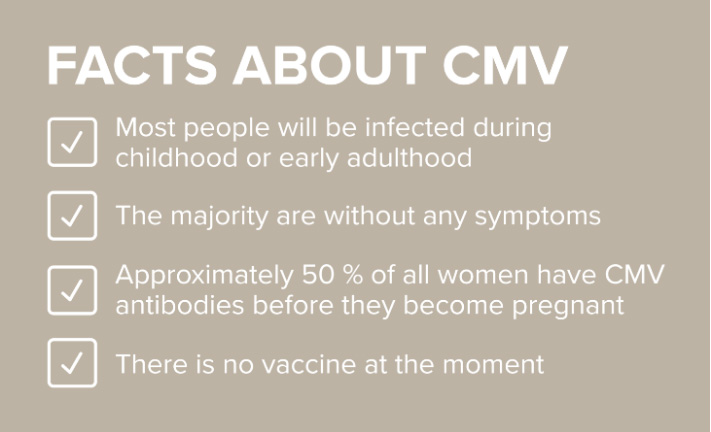
Cytomegalovirus (CMV) is related to the herpes virus and is a common virus that can affect anyone. You can get infected through body fluids such as saliva, blood, urine, sperm and breast milk. Most people will get infected and become CMV positive during their childhood or early adulthood. Once infected, the virus lies dormant in the body forever, with little risk of getting reactivated. This is known as a recurrent CMV infection and is measured in CMV negative and CMV positive.
Other articles about pregnancy
What is CMV status?
Your CMV Status means to be either CMV positive or CMV negative. The first time you get infected you create antibodies called CMV IgM and CMV IgG. IgM antibodies are present during acute infection, IgG antibodies stay forever.
What is CMV positive?
If you are CMV positive it means that you have been infected with the virus cytomegalovirus or CMV. Once you have been infected you create antibodies called CMV IgM and CMV IgG, which stay in your body forever. Here below, we have explained how it is possible to become CMV positive:
- When no IgM antibodies are present, but IgG antibodies are present, a person is CMV positive. This means that he/she has had a CMV infection in the past but does not have an acute infection.
- When IgM and IgG antibodies are present, there is an acute infection. If a sperm donor has an acute infection with CMV, he/she cannot donate in that period.
What is CMV negative?
When no IgM antibodies nor IgG antibodies are present a person is CMV negative. This means that he/she has never been infected by CMV.
Free ebook about pregnancy
Hopefully, our blog post about CMV has proven to be helpful. If you want to learn even more about pregnancy, you can download our free ebook with knowledge and advice about pregnancy and birth. The book is written by our trained midwife Julie.
What does CMV status mean in terms of choosing a sperm donor?
We accept all types of donors, both CMV negative and CMV positive, as long as it is combined with a negative IgM (no current infection). Any donor with a CMV negative status in the Sperm Donor Search has never had a CMV infection. Donors with a CMV positive status in the Donor Search have previously had a CMV infection and have antibodies.
Not all countries require CMV status screening. Therefore, the donors who have no CMV status shown in the Donor Search have not and will not be screened for CMV.
How Cryos screen sperm donors for CMV status
At Cryos, we perform sperm donor screening on all the candidates for a wide variety of viruses and genetic disorders. We also screen our donors to check whether they are CMV positive or CMV negative to accommodate use in some countries. We accept only donors who have tested IgM negative. This means that the donors do not have an active CMV infection.

Chances of transmitting a CMV infection to your baby
If you are a CMV positive recipient:
Approximately 50% of women are CMV positive, meaning they have already been infected with CMV at some point and have developed antibodies. This offers a level of protection, making them less likely to pass on the virus to their baby. Although the virus can reactivate during pregnancy, the risk of transmission to the baby in these cases is very low, around 1–2%. So, if your first CMV infection occurred before pregnancy, the risk of your baby being affected is small.
If you are a CMV Negative Recipient:
If you have never been infected with CMV (CMV negative), you do not have antibodies. If you are exposed to CMV for the first time during pregnancy, the risk of passing the virus to your baby is significantly higher. This is why your own CMV status - and your sperm donor's - is important to consider when undergoing fertility treatment. Choosing a CMV negative donor may help reduce the risk of a primary infection during pregnancy.
Will my baby be affected by an acute CMV infection?
Most babies with a CMV infection never show signs or have any health problems. Some babies infected with the virus during pregnancy may, however, have health problems that are apparent at birth or develop later during infancy or childhood. If you want to know more about CMV, we recommend that you speak with your doctor or clinic for advice. They can also test you if you are curious whether you are CMV positive or CMV negative.
If you are about to choose a sperm donor for fertility treatment and are worried about CMV, contact our Customer Care, which will answer any question you might have. We are ready to help you with any concerns.
Common FAQs on CMV (Cytomegalovirus)
- Why is CMV status important when finding a sperm donor?
It is important to focus on CMV status while trying to become pregnant since it sometimes causes problems in the baby. Therefore, we screen our sperm donors to make sure they are not CMV positive. - How do you reduce your chances of being infected with CMV (Cytomegalovirus)?
Cytomegalovirus is mainly spread through close contact, sexual contact, and body fluids. Therefore, if you are a pregnant woman working closely with children or people who might have an active CMV status, you need to be careful. - Is CMV considered an STD?
While being a member of the herpes family, the CMV infection is not considered an STD. - How contagious is CMV?
Cytomegalovirus is only contagious when active and only transmits through close contact with the infected. - What are the most common CMV symptoms?
The majority are without any symptoms, but a few may develop fever, sore throat and headache. It can be hard to spot the symptoms of CMV infection since they are similar to the symptoms of typical flu. Below, we have made a list of the most common symptoms of CMV:- Fever
- Sore throat
- Headache
- Skin rash
- Swollen glands
If you experience any of these symptoms while pregnant, you should consider contacting your doctor to schedule an appointment.