Knowing the day your ovulation occurs is an important part of home insemination, as the chances of success increase if the insemination occurs close to the ovulation. Therefore, we suggest tracking your cycle for a few months before trying to become pregnant. If you are ready to begin your journey towards parenthood, click on the button below to visit our free Donor Search.

What is ovulation?
The term ovulation means that a mature egg (in rare cases, more than one) has been released from your ovaries. After release, the egg moves down to the fallopian tube, where it is possible for the sperm cells to fertilize the egg. Sperm cells can live inside the female reproductive system for up to five days, depending on their initial quality. This means that fertilization can happen if intercourse or insemination takes place within these days, even if ovulation has not yet occurred. However, sperm motility and fertilizing ability decrease over time. Sperm that has been inside the body for 4-5 days is less likely to cause pregnancy than sperm introduced close to ovulation. The egg itself is only viable for about 12-24 hours after ovulation, so timing intercourse or insemination close to ovulation is key. The best time to perform insemination or have intercourse is around 24 hours after your LH surge.
A positive urine ovulation test usually means that ovulation is likely to occur within the next 24–48 hours, although timing varies from person to person and between test products. Follow the instructions provided with your ovulation test and Cryos order, as well as any advice from your healthcare professional.
How to time your insemination and ovulation?
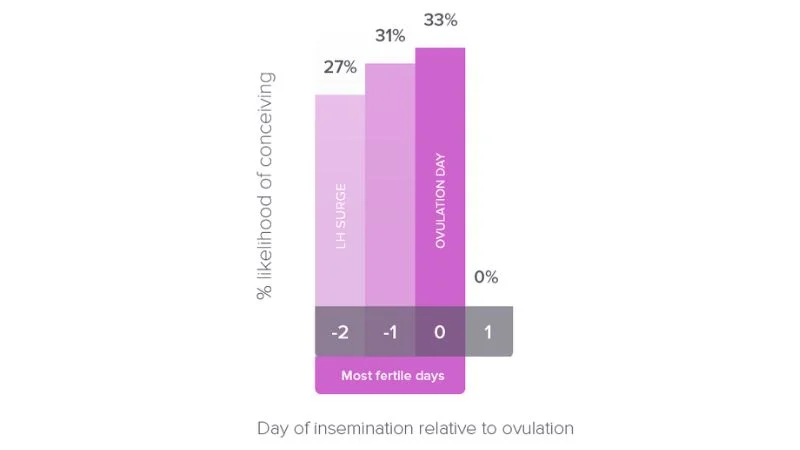
The best way to time your insemination with your ovulation to increase your chances of success, is to track your ovulation a few months before the insemination, thus ensuring that you know when your ovulation will occur. The graph above illustrates the likelihood of conceiving via insemination on the days leading up to your ovulation, showing that the days between your LH surge and ovulation are the best time for insemination.
Most women need a few tries to get it right, which is why we recommend ordering two sperm straws for home insemination, allowing you to space out your insemination along your predicted fertile window
Tracking your ovulation
The best way to track your ovulation is to start with the first day of your last menstrual period or by calculating 12 – 16 days from the next expected period. There is also a vast selection of different ovulation tracking tools available at pharmacies, supermarkets, or online. We recommend using more than one method to track your ovulation, to increase your chances of correctly predicting your ovulation.
Methods of ovulation tracking include
- Phone apps
- Testing kits
- Monitors
- Testing strips (can be purchased in bulk at a low cost online or at large retailers)
- Calendars
- Basal body temperature
- Tracking bracelets
- Cervical mucus
Suggested tools to track
- OvaGraph
- OvaCue
- Print a Calendar – provided by American Pregnancy Association
- Ava Bracelet
Menstrual cycle graph
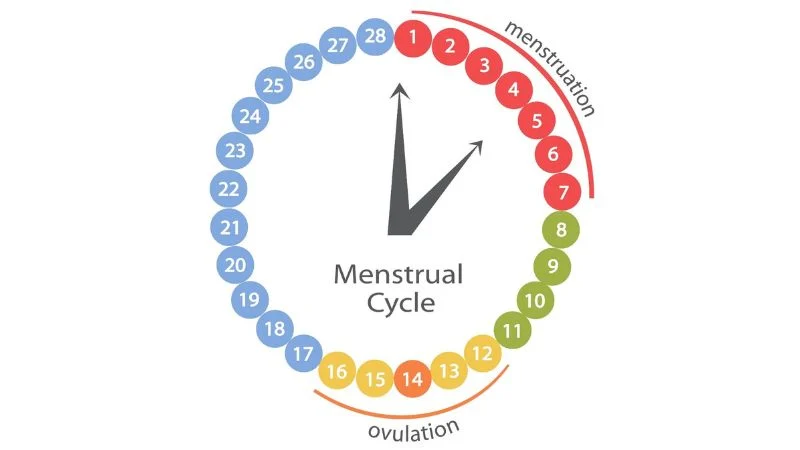
This helpful graph depicts the average 28-day menstrual cycle, including menstruation and peak ovulation. It is important to remember that the graph shows an average menstrual cycle, as the length may vary from one woman to another.
How does ovulation work?
Stage 1 - Menstrual cycle
Estrogen and progesterone levels are low when your period begins. Your period starts when the lining of your thickened uterine wall starts shedding. Typically, periods last between four to seven days.
Stage 2 - The follicular (also called pre-ovulatory) phase
This stage begins on the first day of your period and lasts approximately 10-17 days. Your pituitary glands send various signals out to adjust your hormone levels, including the Follicle Stimulating Hormone (FSH). The FSH triggers your follicles to develop mature eggs. Many follicles are released during this phase, but only one matures into an egg, while the rest disintegrate. Before the egg is released, the lining of your uterus will thicken to prepare for the possible implantation.
Additional facts to know
- Implantation of a fertilized egg normally takes place 6-12 days after ovulation, according to the American Pregnancy Association.
- Ovulation can occur even if your period has not happened.
- Sperm can live up to five days inside the female reproductive tract, but their motility and ability to fertilize an egg decrease over time. The chances of pregnancy are highest within the first 24 hours after sperm enters the body.
- The mature egg lives 12-24 hours after leaving the ovary.
- Normally only one egg is released from one ovary during ovulation.
- A typical cycle is between 28-32 days, but some women may have longer or shorter cycles.
Stage 3 - The ovulatory phase
Ovulation happens mid-cycle in response to a peak in estrogen. This can occur on any day of the Follicular phase above. The estrogen peak triggers the release of the Luteinizing Hormone (also called the LH surge). The surge causes the egg to push through the ovarian wall. This takes between 24-36 hours. The egg then travels to the fallopian tubes for fertilization. This is the optimal time for insemination.
Stage 4 - The Luteal phase
This stage lasts approximately 14 days and marks a decrease in the FSH. If a fertilized egg has not attached itself to the uterine wall during this stage, the uterine lining will absorb the unfertilized egg, and your menstrual cycle will start again.
Relevant guides for home insemination
Contact Cryos
If you have any questions about ovulation or anything else related to treatment with donor sperm, our Customer Care Team is available by phone at +1 (407) 203 1175, email [email protected], or chat on our website.